
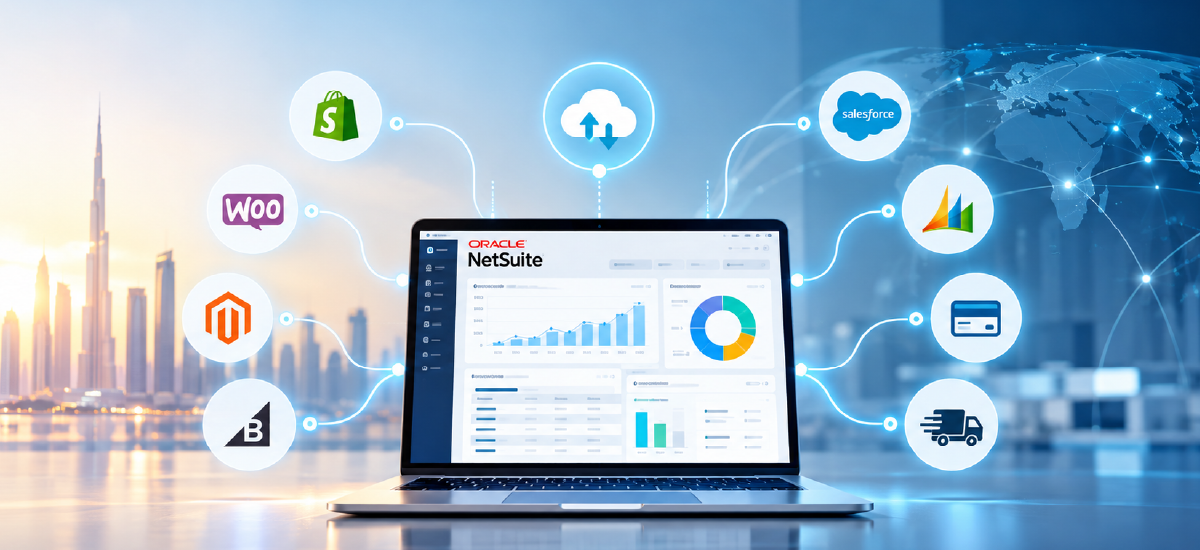
Modern businesses rely on multiple applications to manage sales, customers, inventory, finance, operations, and online commerce. However, when these systems operate independently, businesses often face duplicate data, manual processes, delayed updates, and limited visibility.
NetSuite integration connects your ERP with e-commerce platforms, CRM systems, payment solutions, logistics applications, and other business software creating a connected digital ecosystem where information can move seamlessly between systems.
For businesses looking to automate operations and improve real-time visibility, NetSuite Integration Services can help connect critical applications while reducing manual data entry and operational complexity.
What Is NetSuite Integration?
NetSuite integration is the process of connecting Oracle NetSuite ERP with third-party applications, platforms, and business systems.
An integrated NetSuite environment can synchronize important business information such as:
- Customer and contact records
- Sales orders and invoices
- Products and inventory
- Payments and transactions
- Fulfillment and shipment information
- Purchase orders
- Pricing and product information
- Financial data
- Customer interactions
- Employee and operational information
Instead of manually transferring information between systems, integration allows data to flow automatically according to defined business processes.
Why Is NetSuite Integration Important?
As businesses grow, managing information across disconnected applications becomes increasingly difficult. Employees may need to enter the same information into multiple systems, increasing the possibility of errors and delays.
NetSuite integration can help businesses create a more connected workflow by allowing different applications to communicate with the ERP.
1- Reduce Manual Data Entry
Integration can automate repetitive tasks such as transferring e-commerce orders, updating customer records, and synchronizing inventory.
This reduces the need for employees to manually enter the same information in multiple systems.
2- Improve Data Accuracy
When information is transferred automatically between connected systems, businesses can reduce inconsistencies caused by manual data entry.
For example, inventory information maintained in NetSuite can be synchronized with an e-commerce platform to provide more consistent stock availability.
3- Improve Real-Time Visibility
Integrated systems can provide businesses with better visibility across sales, inventory, customers, and financial operations.
Management teams can access information from connected business processes without relying on multiple disconnected data sources.
4- Automate Business Workflows
NetSuite integration can automate workflows between different applications.
For example: Customer places an online order → Order enters NetSuite → Inventory is updated → Fulfillment is processed → Shipment information is synchronized → Financial records are updated.
NetSuite E-Commerce Integration
E-commerce businesses often use multiple platforms to manage their online stores, payments, fulfillment, and inventory.
Connecting an e-commerce platform with NetSuite can bring online sales and back-office operations together.
NetSuite can be integrated with popular e-commerce platforms such as:
| Shopify | WooCommerce | Magento | BigCommerce | Other custom e-commerce platforms |
What Can Be Synchronized?
Depending on business requirements, an e-commerce integration can synchronize:
| Customer information | Products | Product pricing | Inventory | Sales orders |
| Order status | Fulfillment details | Shipment information | Returns | Payments |
This creates a more connected e-commerce operation and helps businesses manage online orders from a centralized ERP environment.
NetSuite CRM Integration
Customer information is often distributed across ERP, CRM, marketing, sales, and customer-support systems.
NetSuite CRM integration can help businesses connect customer-related information across these platforms.
Businesses can integrate NetSuite with CRM and customer-facing applications to improve information sharing between sales, finance, operations, and customer service teams.
A connected CRM and ERP environment can help organizations maintain more consistent customer information and improve visibility throughout the customer lifecycle.
NetSuite Integration With Business Applications
NetSuite does not have to operate as a standalone ERP. Businesses can connect NetSuite with a wide range of applications used throughout their operations.
Common integration areas include:
Payment Gateways
Connect payment systems with NetSuite to streamline transaction and payment reconciliation processes.
Shipping & Logistics
Synchronize fulfillment, shipment, and delivery information between NetSuite and logistics applications.
Marketplaces
Connect online marketplaces with NetSuite to centralize orders, customers, inventory, and fulfillment information.
Marketing Platforms
Connect marketing applications with customer and sales data to support more connected marketing workflows.
Business Intelligence & Analytics
Integrate data sources with analytics platforms to improve reporting and business intelligence.
Custom Applications
Businesses with specialized workflows can integrate NetSuite with custom-built applications and internal systems.
Common NetSuite Integration Methods
The right integration approach depends on the applications involved, data requirements, transaction volume, security requirements, and business processes.
Common approaches include:
SuiteTalk APIs
NetSuite SuiteTalk provides APIs that can be used to connect NetSuite with external applications and systems.
Middleware & Integration Platforms
Businesses can also use integration platforms and middleware solutions to connect NetSuite with multiple applications.
Platforms such as Celigo and Tray.ai can support integration workflows between NetSuite and third-party applications.
SuiteScript
SuiteScript can be used to create customized business logic and integration workflows within NetSuite.
Custom Integration Solutions
For complex requirements, businesses may need custom integration architecture designed around their specific processes and applications.
How to Plan a Successful NetSuite Integration
Before implementing an integration, businesses should evaluate their existing technology environment and business processes.
Step 1: Identify Business Requirements
Determine which applications need to be connected and what business processes should be automated.
Step 2: Define Data Flows
Identify which data needs to move between systems and determine how frequently it should be synchronized.
Step 3: Select the Integration Approach
Choose between APIs, SuiteScript, middleware, integration platforms, or custom solutions based on technical and business requirements.
Step 4: Establish Data Mapping
Define how fields and records in one system correspond to fields and records in another system.
Step 5: Test the Integration
Test data synchronization, error handling, workflows, and transaction processing before going live.
Step 6: Monitor & Optimize
Integration should be monitored after deployment to identify errors, performance issues, and opportunities for further automation.
NetSuite Integration for Growing Businesses
As businesses expand into new sales channels and adopt more specialized applications, integration becomes increasingly important.
A connected ERP environment can help businesses manage operations across:
| E-commerce stores | Retail channels | Wholesale operations | CRM systems | Marketplaces |
| Payment platforms | Logistics providers | Financial applications | Custom business applications | and more… |
Rather than managing each application independently, organizations can build an integrated technology ecosystem around NetSuite.
NetSuite Integration Partner
Choosing the right integration partner can make a significant difference when connecting NetSuite with e-commerce platforms, CRM systems, and business applications.
Dynasoft Cloud provides NetSuite Integration Services to help businesses connect NetSuite with their existing technology ecosystem.
As an experienced NetSuite integration partner, Dynasoft Cloud works with businesses to design and implement integration solutions based on their operational and technical requirements.
Our integration expertise includes connecting NetSuite with platforms such as:
| Shopify | WooCommerce | BigCommerce | Magento | CRM systems |
| Payment platforms | Marketplace applications | Logistics and shipping systems | Custom business applications | Celigo and other integration platforms |
From data mapping and API integration to workflow automation and synchronization, Dynasoft Cloud can help businesses create a more connected NetSuite environment.
Dynasoft Cloud can help you connect NetSuite with the applications your business relies on.
Talk to our NetSuite Integration Services team to explore an integration strategy tailored to your business.