
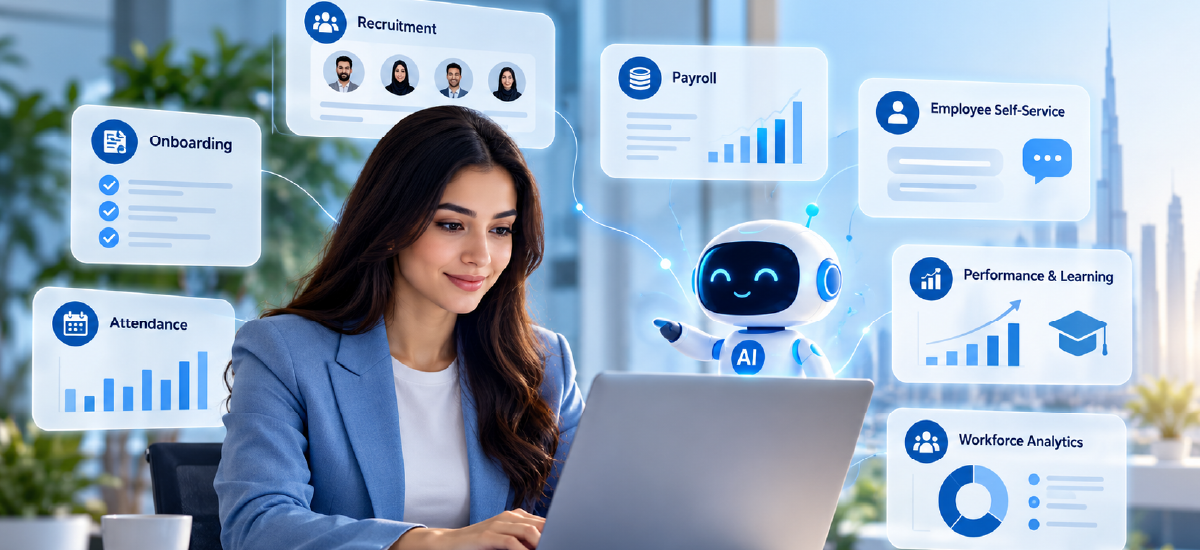
Human Resource Management is evolving rapidly as businesses embrace digital transformation, automation, and data-driven decision-making. Traditional HR processes that once depended on spreadsheets, paperwork, and repetitive manual tasks are increasingly being replaced by intelligent systems. One of the most significant developments in this transformation is Artificial Intelligence (AI) in Human Resource Management Systems (HRMS).
AI-powered HRMS solutions help organizations automate routine HR tasks, improve employee experiences, analyze workforce data, and make more informed decisions. From recruitment and employee onboarding to payroll management, attendance tracking, and workforce planning, artificial intelligence is reshaping how HR departments operate.
For growing businesses in Dubai, the UAE, and across the Middle East, integrating AI capabilities into HR management can help improve operational efficiency, support business growth, and create a more agile workforce.
What Is AI in HRMS?
AI in HRMS refers to the use of artificial intelligence technologies, including machine learning, natural language processing, predictive analytics, and intelligent automation, to enhance human resource management processes.
An AI-enabled HRMS can analyze workforce data, identify patterns, assist with employee queries, automate repetitive activities, and generate insights that support HR decision-making.
Unlike traditional HR software, which primarily records and processes employee information, AI-enabled HR systems can help interpret data and identify opportunities for improvement.
For example, an AI-powered HRMS may help HR teams identify attendance trends, forecast workforce requirements, answer frequently asked employee questions, and streamline recruitment workflows.
The goal is not to replace HR professionals. Instead, AI helps HR teams spend less time on administrative work and more time on employee engagement, talent development, and strategic workforce planning.
8 Ways Artificial Intelligence Is Transforming HR Management
1. Smarter Recruitment and Talent Acquisition
Recruitment involves multiple time-consuming activities, including reviewing applications, screening candidates, scheduling interviews, and coordinating with hiring managers.
AI can support these processes by helping recruiters organize applications, identify relevant skills, match candidates against job requirements, and automate interview scheduling.
Intelligent recruitment tools can also help HR teams develop job descriptions and analyze hiring trends.
Business benefits:
- Reduced manual recruitment workload.
- Faster candidate screening and coordination.
- Improved visibility into recruitment pipelines.
- More consistent evaluation criteria.
AI-generated recommendations should always be reviewed by recruiters. Human oversight is essential to reduce bias, protect candidate privacy, and ensure hiring decisions remain fair and explainable.
2. Automated Employee Onboarding
Employee onboarding involves collecting documents, assigning tasks, sharing policies, arranging training, and coordinating with multiple departments.
An AI-enabled HRMS can help streamline onboarding by automating reminders, answering common questions, guiding employees through required procedures, and identifying incomplete onboarding tasks.
New employees can receive timely information about company policies, leave procedures, attendance rules, and payroll requirements.
By simplifying these processes, businesses can create a more organized onboarding experience while helping HR teams manage new hires more efficiently.
3. Intelligent Attendance and Workforce Management
Attendance and workforce management are important for businesses with multiple departments, shifts, and locations.
AI can analyze attendance records to identify recurring patterns, highlight unusual entries, and support workforce planning. When combined with configured attendance rules and approval workflows, an HRMS can also reduce manual attendance corrections and administrative follow-ups.
For example, businesses operating in retail, manufacturing, hospitality, and professional services can use workforce data to understand staffing requirements and identify recurring scheduling challenges.
AI-generated alerts should be treated as indicators for review rather than automatic proof of employee misconduct.
4. AI-Powered Payroll and Compensation Management
Payroll processing requires accurate employee information, attendance records, salary structures, allowances, deductions, and approved adjustments.
An HRMS can automate payroll calculations using configured business rules, while AI can assist with identifying unusual payroll variations, detecting possible data inconsistencies, and highlighting records that require further review.
For example, a system may flag an unexpected change in overtime costs or identify a discrepancy between approved attendance and payroll inputs.
These capabilities can help HR and finance teams investigate potential errors before payroll is finalized.
However, payroll accuracy still depends on correct source data, validated business rules, applicable tax and labor requirements, and authorized human review. AI should support payroll controls rather than independently determine employee entitlements.
5. Personalized Employee Self-Service
Employees frequently contact HR to ask about leave balances, attendance records, payroll information, company policies, and internal procedures.
AI-powered virtual assistants and chatbots can answer common questions, guide employees to relevant information, and help them navigate HR systems.
For example, an employee may ask how to submit a leave request or where to find a payslip. An AI assistant can provide instructions or direct the employee to the appropriate HRMS feature.
This reduces repetitive queries and allows HR professionals to focus on more complex employee concerns.
Access to confidential information must remain controlled through authentication, role-based permissions, and appropriate data protection measures.
6. Predictive Workforce Analytics
Workforce planning becomes more effective when HR teams can understand trends instead of relying exclusively on historical reports.
AI-powered analytics can help organizations examine patterns in employee turnover, absenteeism, recruitment, workforce costs, and staffing requirements.
For example, historical data may reveal departments experiencing increasing turnover or recurring attendance challenges. HR teams can investigate the underlying causes and develop targeted retention or workforce planning strategies.
Predictive analytics can support decisions about:
- Future staffing requirements.
- Employee retention initiatives.
- Workforce cost management.
- Training and development priorities.
- Recruitment planning.
Predictions are estimates, not guarantees. Their reliability depends on data quality, appropriate models, and regular evaluation.
7. Employee Performance and Learning Development
AI can help organizations identify skills gaps, recommend relevant training resources, and support employee development planning.
By analyzing job requirements, skills assessments, and training records, an HRMS may help managers identify areas where employees could benefit from additional learning.
AI can also assist in preparing performance review summaries and organizing feedback, provided the information is accurate and used appropriately.
Performance decisions should not rely solely on automated scores or algorithmic recommendations. Managers must consider context, employee feedback, role expectations, and measurable evidence.
8. Better HR Reporting and Strategic Decision-Making
Traditional HR reporting often requires teams to collect information from multiple spreadsheets and systems before preparing management reports.
AI-assisted reporting can help summarize workforce trends, identify changes in key metrics, and translate HR data into understandable insights.
Management teams can use these insights to assess employee headcount, attendance patterns, payroll costs, recruitment performance, and workforce productivity.
When supported by reliable data and clear reporting definitions, AI can help HR departments move from administrative reporting toward more strategic decision-making.
AI in HRMS vs. Traditional HRMS
Traditional HRMS platforms primarily focus on storing employee information and automating predefined HR workflows. AI-enabled HRMS solutions can extend these capabilities through intelligent analysis, recommendations, and natural-language interactions.
| Capability | Traditional HRMS | AI-Enabled HRMS |
|---|---|---|
| Employee records | Centralized employee data | Data analysis and intelligent assistance |
| Attendance | Tracks attendance and configured rules | Can identify patterns and flag anomalies |
| Payroll | Automates configured calculations | Can help identify unusual payroll variations |
| Recruitment | Manages applications and hiring workflows | Can assist with candidate matching and screening |
| Employee queries | Portals and predefined workflows | AI-assisted conversational support |
| Reporting | Standard reports and dashboards | AI-assisted summaries and trend analysis |
| Workforce planning | Historical reporting | Potential predictive insights and forecasts |
The actual capabilities depend on the HRMS platform, integrations, available AI features, and the quality of organizational data. Not every HRMS includes built-in artificial intelligence, and some capabilities require separate tools or integrations.
Key Benefits of AI in HRMS for Businesses in the UAE and Middle East
Organizations across the UAE and the wider Middle East are managing increasingly complex workforce requirements, including multiple locations, diverse employee populations, and evolving compliance obligations.
AI-enabled HRMS capabilities can help businesses address these challenges by improving administrative efficiency and workforce visibility.
Key benefits include:
Improved operational efficiency: Automating repetitive tasks gives HR professionals more time for strategic activities.
More informed decisions: Workforce analytics help managers identify trends and investigate potential issues.
Better employee experiences: Self-service tools and AI assistants make HR information easier to access.
Scalable HR operations: Standardized workflows can help growing organizations manage larger workforces.
Stronger workforce visibility: Centralized employee information and reporting can help management understand staffing and attendance patterns.
Support for compliance processes: Configured workflows, approval records, and reporting can support internal controls and compliance monitoring. Businesses must still validate applicable UAE labor, payroll, privacy, and other regulatory requirements.
Challenges of Using AI in Human Resource Management
Although AI offers significant opportunities, businesses should address several challenges before implementing it.
Data privacy and security: Employee information must be handled securely and in accordance with applicable privacy requirements.
Algorithmic bias: Biased data or poorly designed models can produce unfair recruitment, performance, or workforce recommendations.
Integration complexity: Connecting AI capabilities with existing HRMS, payroll, ERP, and attendance systems may require technical planning.
Data quality: Incomplete or inconsistent employee records can reduce the reliability of AI-generated insights.
Employee trust: Organizations should explain how AI is used, what information it processes, and when human decisions remain essential.
Cost and change management: Implementation, training, system integration, and ongoing monitoring require resources.
A responsible AI strategy combines suitable technology with transparent processes, employee communication, regular testing, and human accountability.
How Dynasoft Cloud Can Help Businesses Modernize HR Management
Dynasoft Cloud helps businesses explore digital solutions that streamline business operations and improve organizational efficiency. For companies looking to modernize human resource management, an HRMS can provide a structured foundation for automating essential HR activities.
An HRMS solution can support key processes such as:
| Payroll management: Configured gross and net pay calculations, earnings, deductions, and payroll reporting. | Attendance management: Attendance configurations, shift setups, roster plans, and dynamic attendance statuses. | Approval workflows: Structured employee requests and approval processes. |
| Employee information management: Centralized employee records and access to relevant HR information. | HR analytics and reporting: Workforce information to support operational monitoring and management decisions. | – |
These capabilities provide a foundation for more efficient HR operations. Where suitable AI features or integrations are available, businesses can explore additional opportunities for intelligent reporting, employee assistance, and workforce analytics.
Dynasoft Cloud can help organizations evaluate their business requirements and identify opportunities to improve HR processes through appropriate digital solutions.
Whether your organization is streamlining payroll, standardizing attendance management, or preparing to scale its workforce, selecting the right HRMS is an important step toward sustainable digital transformation.